Hero Precision Jet – Precision Right to the Edge
Sonplas Expands HERO Technology to External Surfaces and Edges
Sonplas’ patented Hydro-Erosive Machining (HERO) process delivers efficient, highly reliable deburring and precision edge rounding of internal bore intersections. With the HERO Precision Jet, Sonplas extends this proven technology to external surfaces and edges. The process ensures consistent, repeatable results, enhances surface finish quality, and creates the ideal foundation for downstream coating processes. The result is significantly improved component durability and longer service life.
“The quality requirements for component edges in industrial manufacturing continue to increase across a wide range of industries, including toolingmaking, medical technology, and aerospace,” says Andreas Kraus, Development Engineer at Sonplas. “Particularly for cutting tools such as drills and end mills, manufacturers need highly consistent edge radii in the micron range, surface finishes optimized for downstream coating processes, and cost-effective solutions that can be scaled for industrial series production.”
With the HERO Precision Jet, Sonplas has expanded hydro-erosive machining to include the precise processing of external surfaces and edges. The process uses a custom-engineered suspension of water or hydraulic oil and abrasive particles, which is directed at the component under carefully controlled conditions. Edge radii can be precisely tailored by adjusting process parameters such as pressure and cycle time. Operating pressures typically range from 50 to 150 bar. “To maintain a tightly focused jet, the nozzle-to-part distance is kept short, typically between 8 and 20 millimeters,” explains the Sonplas expert. Depending on the target edge radius, processing time can be precisely adjusted for each workpiece. The nozzle angle can also be varied to selectively achieve different edge geometries on the cutting and trailing edges.
Rather than processing the entire component, the HERO Precision Jet targets only the edges that are critical to performance. Even on larger-diameter cutting tools, the process is focused exclusively on the cutting edges, leaving the flutes unaffected. “In addition to rotationally symmetric components, the technology is also well suited for flat and complex geometries, provided the relevant edges are accessible to the jet,” says Kraus.
In most applications, an industrial robot precisely guides the workpiece past multiple jet nozzles. Alternatively, the nozzle itself can be mounted on the robot, enabling targeted processing of flat surfaces and complex geometries. This approach allows intricate or hard-to-reach external contours to be machined with a high degree of repeatability.
Reliable Micron-Level Edge Rounding
“Our HERO Precision Jet can produce edge radii ranging from 10 to 30 microns. Depending on the component and application, both larger and smaller radii can be achieved. The achievable radius is influenced by factors such as material, geometry, and process parameters”, explains Kraus. The result is a uniform, precisely defined edge profile—an important requirement for cutting tools and other performance-critical components.
A key benefit of the process is its exceptional consistency and stability. For each component, the operator creates and stores a process recipe containing the optimal machining parameters. When production switches to a different part, the corresponding settings are automatically recalled, ensuring highly repeatable results without requiring manual adjustments.
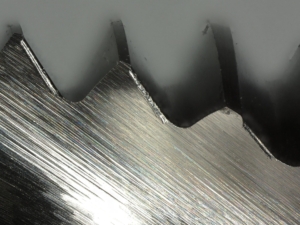
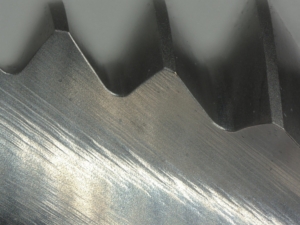
Before machining with Precision Jet After machining
Automation: A Key Advantage
“We designed the machine platform from the ground up for industrial series production environments,” explains Andreas Kraus. In one customer installation, rotationally symmetric tools such as drills and thread mills ranging from M2 to M24 are processed fully automatically. A robot handles the entire part movement process, from picking and positioning to guiding the component through machining. “The system can process up to 400,000 parts per year,” says Kraus. “Actual throughput depends on factors such as the part mix, processing times, shift schedules, and whether loading is performed manually or automatically.” At the same time, the HERO Precision Jet is equally well suited for flexible laboratory and development applications.
Depending on part size and the required edge radius, cycle times typically range from approximately 10 to 120 seconds. This makes the process significantly faster than many alternative methods, which often require several minutes to achieve comparable results. Changeovers are equally efficient. While the operator can swap the robot gripper in just one to two minutes, nozzle positioning is adjusted automatically based on the stored process parameters. This enables manufacturers to adapt quickly to changing part geometries while maintaining consistent process performance.
“To ensure consistent process performance, the HERO Precision Jet is continuously monitored,” says Kraus. “The recorded parameters include media pressure and temperature, as well as media quality, which is monitored through rotational speed measurement. The system also tracks nozzle wear, along with the distance and angle of the nozzles relative to the component.” All of these parameters are recorded and documented, enabling complete process traceability and control. An integrated post-process rinsing station ensures complete removal of the abrasive media from sensitive components—an essential requirement for demanding applications in industries such as medical technology and aerospace.
Enhanced Coating Quality Increases Service Life
The process selectively removes burrs, improves surface quality, and creates a consistent edge profile, providing an ideal foundation for coating adhesion. “Because the coatings are less prone to chipping during operation, tool life can be significantly extended,” says Kraus. “Initial customer feedback has confirmed this positive effect.”
Currently, HERO Precision Jet is primarily used for carbide and steel components. However, drawing on Sonplas’ extensive experience with the original HERO process for internal bore intersections, the technology can be applied to a much broader range of materials, including aluminum, polymers, ceramics, titanium, and Inconel. This versatility makes HERO Precision Jet well suited for a wide range of industries and applications, including precision tooling, hydraulic components, medical technology, chemical processing, and aerospace.
Kraus and his team are now developing a demonstration system that will be used for research and development at Sonplas. The company also plans to use the system to offer contract processing services for customer-specific applications. “This gives customers the opportunity to evaluate the process on their own components before investing in a dedicated production system,” explains Kraus. The approach is particularly attractive for low-volume production runs and pilot projects.
The development of HERO Precision Jet reflects a broader industry trend: proven technologies originally developed for the automotive sector are increasingly being adapted for new applications and markets. “By extending the technology to the precision processing of external edges, we are addressing a market that demands accurate, highly automatable, and scalable solutions—particularly in applications where conventional methods often reach their limits,” says Kraus.
